All Personal Team Leadership Monthly News
Read & Subscribe
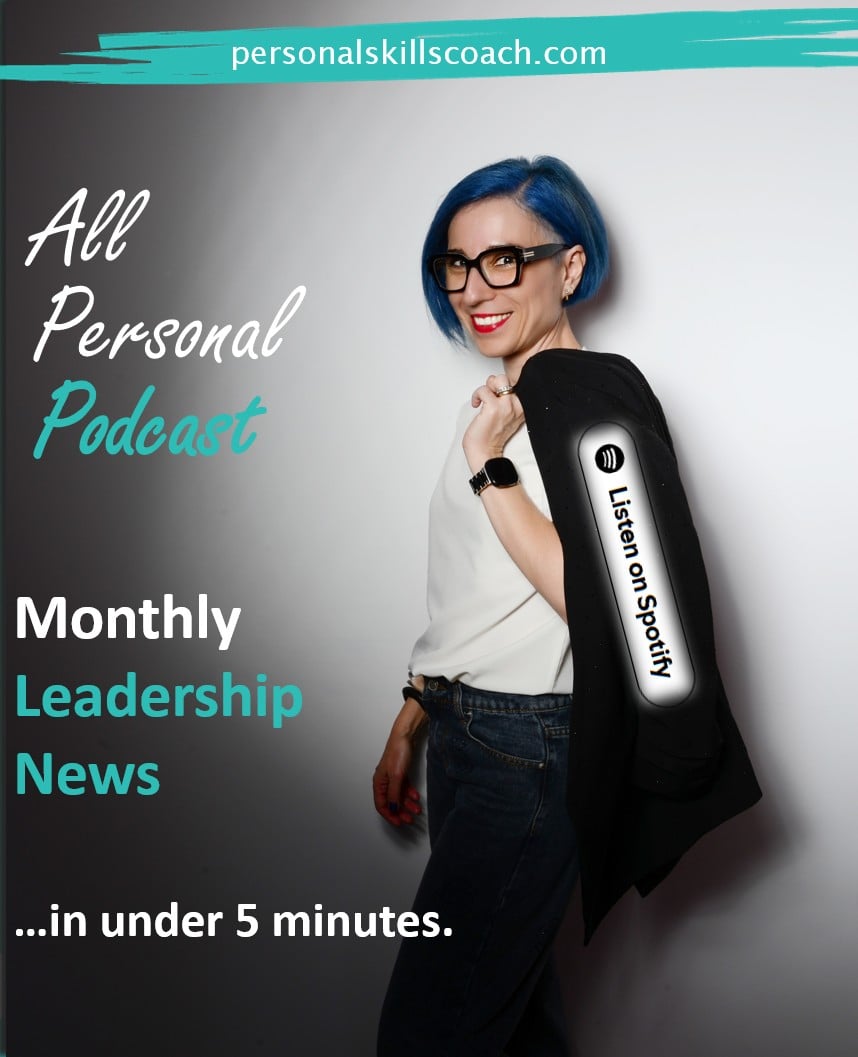
I used Google’s Notebook AI tool to create a short audio brief of this newsletter.
If you’re busy, on the move or an auditory communicator – this is for you!
Click here to listen to the brief.
This month’s topic:
‘Workplace Toxicity and Imposter Syndrome!’ – a different angle.
Not from the books, but from behind the scenes of coaching conversations with real people!
1. Backstage at All Personal – ‘I think I’m toxic!’ or why trusting our thoughts is not always a good idea.
2. Motivation Moment – Game On: Coaching Question Friday Raffle #59 and Coaching Forest Awards!
3. Just One Learning Bite: today, a TED-Ed video on the imposter syndrome and how to fight it!
What’s a struggle or a topic you want me to talk about next month?
Email me and I’ll address that in the next issue.
Game On: Lead Different!
Roxana
‘I think I’m toxic’ said no one about themselves, ever?
Reason for which I’ll just say – I love this topic because I don’t believe ‘toxic’ is an attribute for people.
Substances, yes.
People – nah.
Oh, toxicity within a system, that’s something else!
Well, I do think I myself was toxic in one system or another, at several points in time.
In this conversation with Felicia Stepan, we discussed various ‘toxic’ workplace scenarios, based on questions received from people:
Scenario #1: Gossip and Favouritism
“I work in a marketing team of about 10 people. It feels like one person is always getting the best projects, the boss’s attention, and all the credit—even when we’ve worked on something together.
The rest of us are starting to feel invisible, and it’s causing tension in the team.
I don’t want to stir drama, but it’s getting hard to stay motivated.
What should I do?”
Scenario #2: Passive-Aggressive Feedback and Public Shaming
“One of the senior team members often gives ‘feedback’ in a really sarcastic way during meetings—like, ‘Oh great job, next time maybe actually read the instructions.’
Everyone laughs, but it stings. It’s making me and others nervous to speak up.
I don’t want to sound too sensitive, but is this normal?”
Scenario #3: The Culture of Polite Silence
“In my company, everyone acts nice in meetings, but after the meeting, the real talk starts—whispers, frustrations, things people don’t feel safe saying out loud.
It’s like there’s a hidden version of every conversation.
I want to speak up, but I’m scared it’ll backfire.
How do you deal with this kind of culture?”
Scenario #4: Micro-Avoidances and Emotional Withholding
“I’ve noticed my manager avoids giving feedback—good or bad. They’re friendly, but when there’s a problem, they just go quiet or change the topic.
It’s confusing because I never know where I stand.
I want to do better at work, but I need clarity.
How do you even bring this up without making it awkward?”
Listen in and let me know:
– which scenario resonated with you most
– what other questions would you have?
Let’s continue the detox together, people! And sometimes, that means a good detox from our own thoughts.🙃
Lead Different.
Game On: Detox! 🌳
‘The more I learn, the more I realize how much I don’t know.’ (Albert Einstein)
Imposter Syndrome is our topic in Just One Learning Bite this week!
From Maya Angelou and Albert Einstein, what we call imposter syndrome (or phenomenon) is very common among people who we call high achievers!
I see it in myself in the form of thoughts, feelings, questions like:
* ‘could I have done this better?’
* ‘what if there is something else and better that I need to know, do, say?’
* ‘was that decision smart enough, good enough, informed enough?’, and so on.
I see it (sometimes mirrored) in my clients’ stories:
* ‘I’m not sure I did the right thing, I’m sure someone else would have thought of something better’;
* ‘I feel I’m leading more intuitively.
* ‘I do get great feedback, which surprises me, because I don’t think I did anything special / I don’t think I’m that good.’
Part of this is also related to The Dunning–Kruger effect: ‘a cognitive bias whereby people with low ability, expertise, or experience regarding a type of task or area of knowledge tend to overestimate their ability or knowledge.
Some researchers also include the opposite effect for high performers: their tendency to underestimate their skills.’
I see that all the time – and I do that too: that tendency we have to take our strong skills for granted and think they come as easy to everyone else.
And I think, on the one hand, us questioning our skills and abilities is good, because that’s what keeps us not settling for the good enough, just maybe for ‘good enough for NOW’. Which allows us to continuously learn, improve, grow.
On the other hand, it can definitely be a bummer when, you know, we’d rather get a bit of extra poise and confidence than self-doubt.
So, for today, I’m sharing this insightful TED-Ed video on what imposter syndrome is, who it affects and what you can do about it when it kicks in.
What’s a leadership learning bite you’d like to share?
Lead Different – this week, too:).
Game On: what’s a learning bite you’d like to share?
Roxana